What is Homeopathy?
Homeopathy is one of the most misunderstood systems of medicine in existence. This blog post talks about what actually is, where it came from, and why it's different than other systems of medicine.
Ashley Machart
6/17/20263 min read
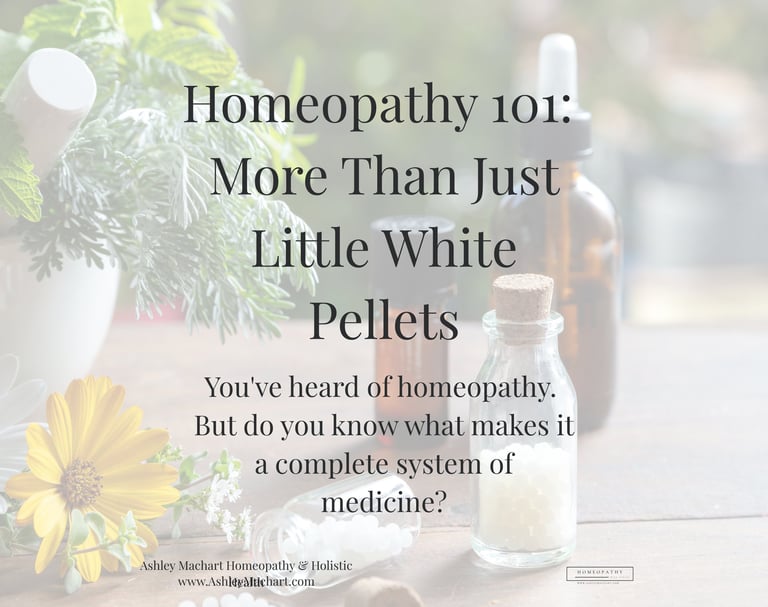
If you've heard of homeopathy, there's a good chance what you think you know isn't quite right.
Maybe you think it's the same as herbal medicine. Maybe you've heard it's just a placebo. Maybe you've seen the little white pellets at the health food store and assumed it was just another natural supplement. Or maybe you've tried it, had a confusing experience, and weren't sure what to make of it.
You're not alone. Homeopathy is one of the most misunderstood systems of medicine in existence, and that misunderstanding often gets in the way of people experiencing what it can actually do, so in this blog post I am going to explain where homeopathy came from, what homeopathy is, and what homeopathy isn't.
Where Homeopathy Came From
Homeopathy was developed in the late 1700s by a German physician named Samuel Hahnemann. Hahnemann was a conventionally trained doctor who became disillusioned with the medical practices of his time — many of which were doing more harm than good. He began experimenting with a different approach, one rooted in observation, testing, and a set of natural laws he discovered through years of careful research.
What he developed became classical homeopathy — a complete, systematic approach to medicine that is still practiced the same way today.
What Homeopathy Actually Is
Here's the most important thing to understand: homeopathy is not a collection of natural remedies you take for symptoms. It is a complete system of medicine with its own laws, principles, and methodology.
That distinction matters more than most people realize. Because when homeopathy is practiced according to its principles, it works in a very specific and predictable way. And when those principles are ignored — which happens more often than you'd think — the results are unpredictable at best and harmful at worst.
Homeopathy is built on the following foundational laws and principles:
The Law of Similars — This is the cornerstone of homeopathy. A substance that produces specific symptoms in a healthy person can be used to treat a sick person experiencing similar symptoms. This is where the word homeopathic comes from — homoios meaning similar, and pathos meaning suffering. Like cures like.
The Single Remedy — In classical homeopathy, only one remedy is given at a time. This allows the homeopath to clearly observe the body's response and assess whether the remedy is working correctly.
The Minimum Dose — Remedies are given in the smallest dose needed to trigger the body's natural healing response. Homeopathic remedies undergo a specific process of serial dilution and succussion — vigorous shaking — known as potentization. More is not better.
Totality of Symptoms — The remedy is chosen based on the whole person — physical, mental, and emotional symptoms together. Not just the diagnosis. Not just the chief complaint. The whole picture.
Individualized Constitution — Because every person experiences illness differently, two people with the same diagnosis will very likely need different remedies. There is no one-size-fits-all approach in classical homeopathy.
Direction of Cure — Healing follows a specific pattern: from the inside out, top to bottom, most vital organs first. A skilled homeopath watches for these signs to know whether a remedy is working and what needs to happen next.
What Homeopathy Is Not
Because there is so much confusion, it's worth being direct about what homeopathy is not.
Homeopathy is not herbal medicine. Herbal remedies use plant substances in material doses for their known chemical properties. Homeopathic remedies are potentized — diluted and succussed — and work on an entirely different principle.
Homeopathy is not a supplement. Supplements address nutritional deficiencies or support specific body systems. Homeopathy addresses the whole person based on their individual symptom picture.
Homeopathy is not the same as taking a remedy that sounds related to your condition. A remedy chosen based on a diagnosis rather than an individual symptom picture is not homeopathy — regardless of what it's called.
Why This Matters for You
Understanding what homeopathy actually is changes how you approach it entirely. Instead of looking for a remedy that matches your diagnosis, you start paying attention to how you experience your symptoms — what makes them worse, what makes them better, what's unusual or strange about how you're feeling.
That shift in thinking is where homeopathy begins to make sense. And it's where the real results start to happen.
If you're new to homeopathy and want a simple, practical starting point, my Quick Start Guide walks you through the basics of how to begin using homeopathy at home — the right way. [Insert link here]
Ashley Machart Homeopathy & Holistic Health
Contact: amachart@ahe.online
© 2026 Ashley Machart Homeopathy & Holistic Health
Training:
Academy for Homeopathy Education
Disclaimer: The information on this website is provided for educational purposes only and is not intended to diagnose, treat, cure, or prevent any disease. Homeopathic consultations are not a substitute for medical care. Clients should consult their primary healthcare provider regarding medical concerns.
Ashley Machart is a clinician who also engages in research alongside HOHM Foundation Office of Research. Please click https://advancehomeopathy.org/disclosures/ for more information. The information provided on this site is not intended as medical advice. Always consult a qualified healthcare provider for medical diagnosis or treatment.